

Knee pain can affect everything—from walking and working to simply enjoying your daily routine. When medications and physiotherapy no longer provide relief, surgery becomes a viable option. But many patients face a common question: partial vs total knee replacement—what’s the difference, and which one is right for you?
Understanding these two procedures can help you make a confident and informed decision about your treatment.
Understanding Knee Replacement Surgery
Knee replacement surgery involves replacing damaged parts of the knee joint with artificial components to restore movement and reduce pain.
There are two main types:
- Partial Knee Replacement (PKR)
- Total Knee Replacement (TKR)
The right choice depends on the extent of joint damage, your lifestyle, and your overall health.
What is Partial Knee Replacement?
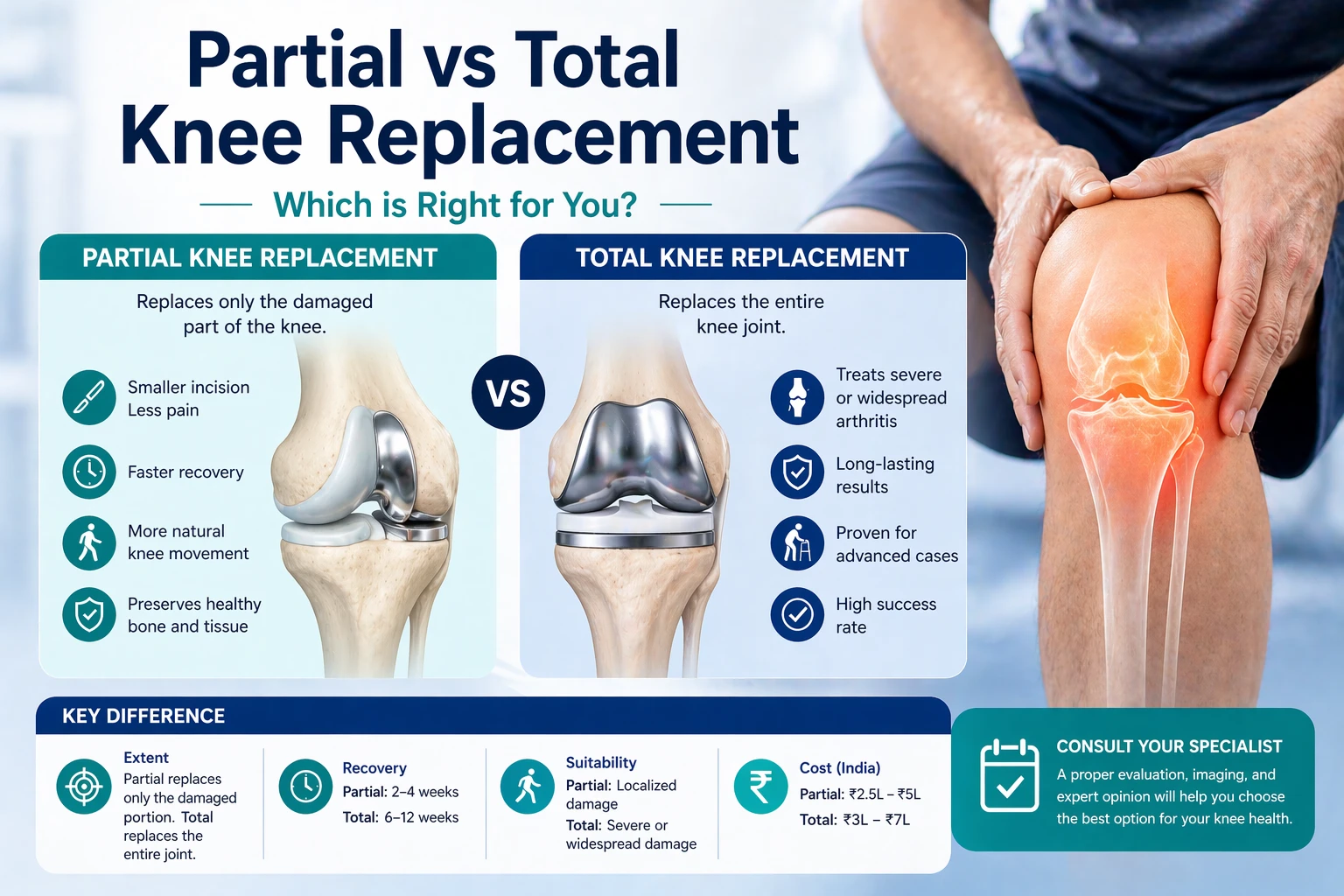
Partial knee replacement is a procedure where only the damaged part of the knee joint is replaced, while the healthy bone and tissue are preserved.
This is typically recommended when damage is limited to a specific compartment of the knee.
Key Features
- Smaller incision
- Preserves natural knee structure
- Faster recovery
- More natural movement after surgery
What is Total Knee Replacement?
Total knee replacement involves replacing the entire knee joint, including all compartments.
This is recommended when the damage is widespread and affects the entire joint.
Key Features
- Complete joint replacement
- Suitable for severe arthritis
- Long-lasting results
- Structured rehabilitation process
Partial vs Total Knee Replacement: Key Differences
| Factor | Partial Knee Replacement | Total Knee Replacement |
|---|---|---|
| Extent of Surgery | Only damaged portion replaced | Entire knee joint replaced |
| Incision Size | Smaller | Larger |
| Recovery Time | Faster (2–4 weeks) | Longer (6–12 weeks) |
| Mobility | More natural movement | Artificial joint feel |
| Suitability | Localized damage | Severe or widespread damage |
| Longevity | May require revision later | Long-lasting solution |
Who Should Choose Partial Knee Replacement?
Partial knee replacement may be right for you if:
- Damage is limited to one part of the knee
- Ligaments are intact
- You have early to moderate arthritis
- You want faster recovery and minimal disruption
Who Should Choose Total Knee Replacement?
Total knee replacement is more suitable if:
- Arthritis affects the entire knee joint
- You experience severe pain and stiffness
- There is significant joint deformity
- Non-surgical treatments no longer work
Cost Comparison in India
| Procedure | Estimated Cost (INR) |
|---|---|
| Partial Knee Replacement | ₹2,50,000 – ₹5,00,000 |
| Total Knee Replacement | ₹3,00,000 – ₹7,00,000 |
Costs may vary depending on hospital, implant type, and surgical technique (including robotic-assisted options).
Recovery and Rehabilitation
| Recovery Stage | Partial Knee Replacement | Total Knee Replacement |
|---|---|---|
| Walking | 1–2 days | 2–3 days |
| Daily Activities | 2–4 weeks | 4–8 weeks |
| Full Recovery | 2–3 months | 3–6 months |
Partial knee replacement generally offers a quicker return to normal activities, while total knee replacement requires more time but provides a more comprehensive solution.
Pros and Cons
Partial Knee Replacement
Pros:
- Faster recovery
- Less pain and scarring
- More natural knee function
Cons:
- Not suitable for all patients
- May need future surgery if arthritis spreads
Total Knee Replacement
Pros:
- Treats entire joint damage
- Long-term relief
- Lower chance of needing another surgery
Cons:
- Longer recovery time
- Larger incision
- Slightly higher cost
How to Decide: Partial vs Total Knee Replacement
Choosing between partial and total knee replacement depends on:
- Extent of knee damage
- Age and activity level
- Overall health condition
- Surgeon’s recommendation
A detailed evaluation, including imaging and physical examination, is necessary to determine the best option.
Platforms like Amuka help simplify this journey by providing access to reliable information and guiding patients toward the right treatment decisions.
Conclusion
When comparing partial vs total knee replacement, there is no one-size-fits-all answer. Partial replacement is ideal for localized damage and faster recovery, while total replacement is better for severe, widespread joint issues.
Understanding your condition and consulting a qualified specialist will help you choose the most effective treatment. With the right approach, you can regain mobility and return to a pain-free life.
Frequently Asked Questions (FAQs)
What is the difference between partial and total knee replacement?
Partial knee replacement replaces only the damaged part of the knee, while total knee replacement replaces the entire joint.
Which is better, partial or total knee replacement?
It depends on the extent of joint damage. Partial is better for localized issues, while total is ideal for severe arthritis.
Is recovery faster with partial knee replacement?
Yes, recovery is typically faster because less tissue is affected during surgery.
How long does a knee replacement last?
Both partial and total knee replacements can last 15–25 years, depending on usage and care.
Can partial knee replacement turn into total later?
Yes, if arthritis progresses, a partial knee replacement may be converted into a total knee replacement later.